Agents: Inflection Point in Software
AI agents are shifting software from tools that assist humans to systems that autonomously plan, build, and operate digital products. This emerging agentic paradigm could redefine the software stack, developer roles, and the future of SaaS.
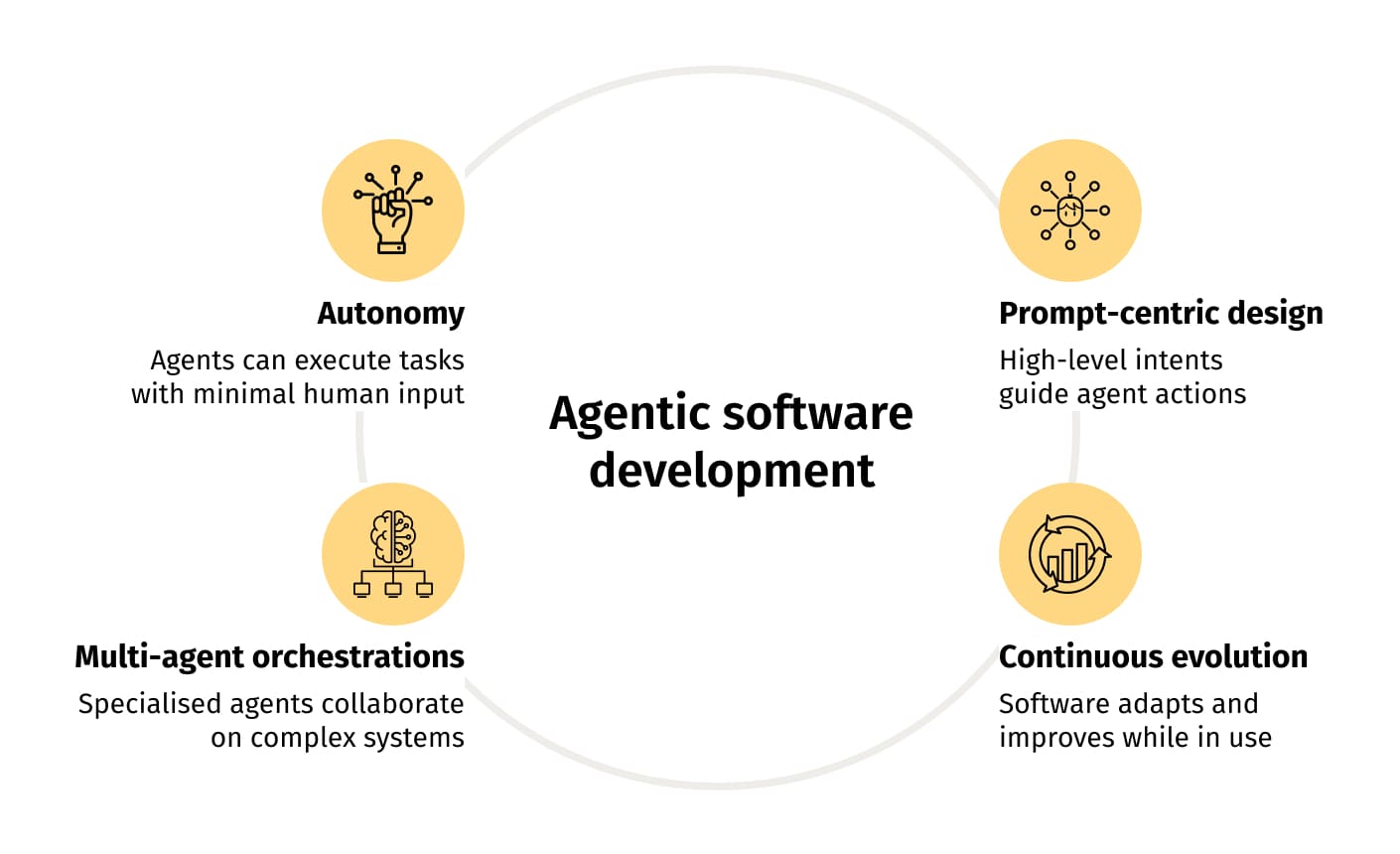
For decades, software evolved in clear phases: manual coding, open-source collaboration, cloud platforms, and AI copilots. Now the industry is entering a new phase — agentic software, where autonomous AI agents plan, execute, and improve work across the software lifecycle.
Recent developments across the industry suggest this is not a marginal improvement but a structural shift in how software is built and consumed.
From Copilots to Autonomous Agents
Early generative AI tools acted as assistants — suggesting code, summarizing documentation, or answering questions. Agents go further.
Agentic systems can now:
- Plan tasks
- Write and modify code
- Run tests
- Deploy services
- Monitor systems
- Iterate based on feedback
This shift moves AI from tool → collaborator → operator. In many environments, agents already analyze bugs, propose code changes, run tests, and prepare pull requests for developers to review.
Software Is Becoming Autonomous
Industry momentum is accelerating. Companies are building platforms where agents automate large parts of the software development lifecycle.
Enterprise systems are beginning to coordinate AI agents to handle planning, coding, testing, and optimization of applications.
This signals the emergence of autonomous software pipelines, where human engineers supervise systems rather than manually performing each task.
The concept is often referred to as agentic coding — software development driven by AI agents that can make decisions and continuously improve systems based on runtime feedback.
Why This Is an Inflection Point
Three forces are converging to push agents into the core of the software stack.
1. AI Can Now Act, Not Just Generate
Recent models can reason across multiple steps and interact with tools, APIs, and environments. Agents combine reasoning with execution systems that allow them to perform real work.
2. Software Is Becoming AI-Native
The next generation of applications is being designed with AI as the core runtime component rather than a feature layered on top.
This shift may reshape the application layer of the software industry, potentially transforming how SaaS products are built and consumed.
3. Multi-Agent Systems Are Emerging
Instead of a single AI assistant, companies are deploying teams of agents that collaborate across tasks — engineering, operations, research, and customer support.
This creates a new architecture: human + agent teams.
The New Software Stack
As agents become first-class participants in software systems, the stack is evolving.
Old stack
- Applications
- APIs
- Databases
- Cloud infrastructure
Emerging agent stack
- AI agents
- Orchestration frameworks
- Tool and API interfaces
- Memory and knowledge systems
- Execution environments
In this architecture, applications become orchestrations of agents rather than static codebases.
The Impact on Developers
Agents will not eliminate developers — but they will reshape their role.
Developers increasingly focus on:
- System design
- Architecture
- Agent orchestration
- Evaluation and safety
- Product thinking
Coding itself becomes a smaller portion of the workflow.
What Comes Next
The transition to agentic software is still early, but the trajectory is clear.
The next decade of software may look like this:
- Apps → Agent systems
- Users → Managers of digital workers
- Developers → Designers of autonomous systems
Just as the cloud reshaped infrastructure and mobile reshaped interfaces, AI agents may redefine the fundamental unit of software.
The companies that learn to design, orchestrate, and govern these agents will define the next generation of the software industry.